- Home
Edition
Africa Australia Brasil Canada Canada (français) Català España Europe France Global Indonesia New Zealand United Kingdom United States Skip to content Edition:
Global
Edition:
Global
- Africa
- Australia
- Brasil
- Canada
- Canada (français)
- Català
- España
- Europe
- France
- Indonesia
- New Zealand
- United Kingdom
- United States
Academic rigour, journalistic flair
 ArtVibe1/Shutterstock
The Keepsake Chronicles: stories in times of dementia
Published: March 11, 2026 5.02pm GMT
Kate Irving, Dublin City University, Alex Kornhuber, Trinity College Dublin, Cathy Fowley, Dublin City University
ArtVibe1/Shutterstock
The Keepsake Chronicles: stories in times of dementia
Published: March 11, 2026 5.02pm GMT
Kate Irving, Dublin City University, Alex Kornhuber, Trinity College Dublin, Cathy Fowley, Dublin City University
Authors
-
 Kate Irving
Professor of Clinical Nursing, Dublin City University
-
Alex Kornhuber
Principal Investigator, The Keepsake Chronices, Trinity College Dublin
-
Cathy Fowley
Principal Investigator, The Keepsake Chronicles, Dublin City University
Disclosure statement
The authors do not work for, consult, own shares in or receive funding from any company or organisation that would benefit from this article, and have disclosed no relevant affiliations beyond their academic appointment.
Partners

Trinity College Dublin and Dublin City University provide funding as members of The Conversation UK.
View all partners
DOI
https://doi.org/10.64628/AB.hex73kujx
https://theconversation.com/the-keepsake-chronicles-stories-in-times-of-dementia-270719 https://theconversation.com/the-keepsake-chronicles-stories-in-times-of-dementia-270719 Link copied Share articleShare article
Copy link Email Bluesky Facebook WhatsApp Messenger LinkedIn X (Twitter)Print article
When someone speaks in a language we do not understand, we do not assume their words are meaningless. We assume we are the ones who cannot yet understand them.
You might try gestures, sign language or the few words you recognise to grasp what they are saying. The assumption is always the same: meaning is there. The challenge is translation.
Listening to people living with dementia can sometimes feel similar.
Communication may become slower, fragmented or difficult to follow. It can be tempting to assume that meaning has disappeared. But often the problem is not the absence of meaning. It is that we are struggling to recognise how that meaning is being expressed.
People living with dementia are often trying, sometimes with remarkable persistence, to show us what they mean. Our role becomes something like that of a translator. As with any translation, something may be lost in the exchange, but the essence of meaning remains.
Sometimes that meaning appears in small, unexpected ways. A person who repeatedly asks to “go home”, for example, may not literally mean a building. They may be expressing a need for safety, familiarity or comfort. When we listen carefully, the emotion behind the words often becomes clearer.
 Seamus, County Mayo, Ireland.
The Keepsake Chronicles, Author provided (no reuse)
Seamus, County Mayo, Ireland.
The Keepsake Chronicles, Author provided (no reuse)
Every person carries a lifetime of stories. Dementia may change how those stories are expressed, but it does not erase them.
Humans are natural storytellers. Research in psychology shows that we build our sense of self through the stories we tell about our lives: where we have been, what has happened to us and what we believe. Psychologists refer to this as “narrative identity”. It is the process through which people connect memories of the past with their sense of who they are in the present.
For people living with dementia, maintaining that sense of self remains deeply important. As research on narrative identity shows, the stories people tell about their lives help them hold together a sense of continuity and meaning, even when memory or language become more difficult.
Social withdrawal, however, is both a risk factor for and a common symptom of advancing dementia. When people withdraw socially, their opportunities to make sense of changing circumstances, relationships and identity diminish. Over time, this can erode self-worth.
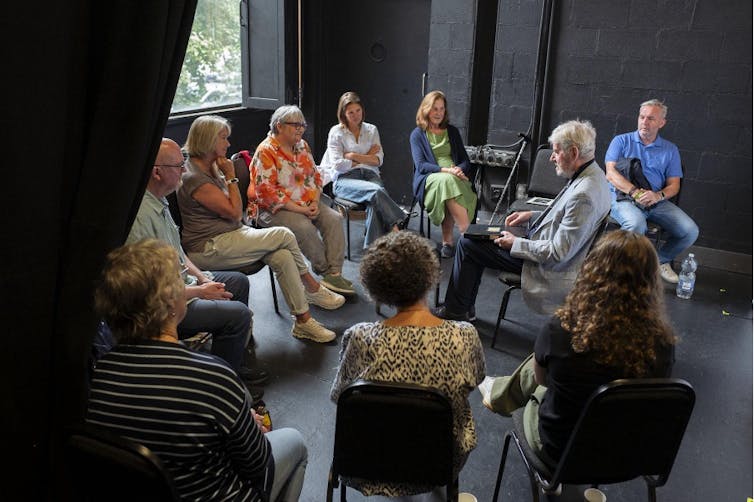 One of The Keepsake Chronicles’s storytelling groups.
The Keepsake Chronicles, Author provided (no reuse)
One of The Keepsake Chronicles’s storytelling groups.
The Keepsake Chronicles, Author provided (no reuse)
The Keepsake Chronicles are storytelling groups for people living with dementia in the community. Participants are invited to bring an object that is meaningful to them, something they have owned for a long time. Objects are tangible. For people living with dementia, physical objects can cue sensory and autobiographical memory in ways that abstract questions often cannot. They can anchor memory and provide a scaffold for storytelling.
Keepsake Chronicles is a collaboration between a nurse, a creative writer and a photographer. As participants tell their stories, we record their words and photograph them in the act of telling. This captures expressions rich with emotion that are inseparable from the stories themselves.
We also photograph the object and then imagine the sense of place embedded in the story, finding ways to recreate it. Sometimes we capture a place as it exists. Sometimes it no longer does, and we respond creatively.
The recorded stories are transcribed and shaped into micro-narratives or poems using only the words and phrases spoken by the person living with dementia. This approach is often described as found poetry, a literary equivalent of collage. Because it preserves a speaker’s own words and rhythms, it allows meaning and emotion to emerge even when speech is fragmented or non-linear.
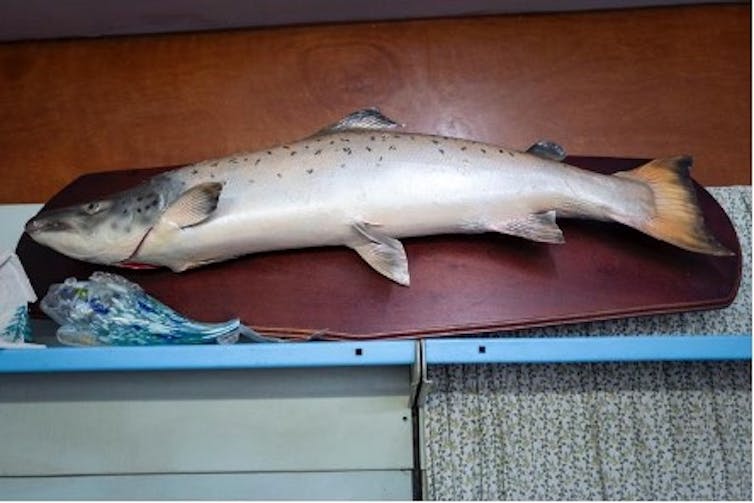
These stories are deeply embedded in geography. Seamus brought a large salmon that had been stuffed by a taxidermist and spoke of his life as a keen fisherman in Mayo.
 The Keepsake Chronicles, Author provided (no reuse)
It was there all our lives
If you look to the river Moy today the salmon have nearly gone extinct it’s so sad there’s very little there now, and if you catch one you throw it back, but it’s so sad No grouse in the bogs, no bird like you always saw – the lark, it’s gone now, the curlew, it’s so sad It’s so sad when I look at all that; you take Lough Mask, the Corrib, the river Moy, it’s so sad to see them dying. Now the hatches aren’t in it, now the birds are gone, it was there all our lives, it’s so sad to see the thing dying in front of us now.
 The Keepsake Chronicles, Author provided (no reuse)
 The Keepsake Chronicles, Author provided (no reuse)
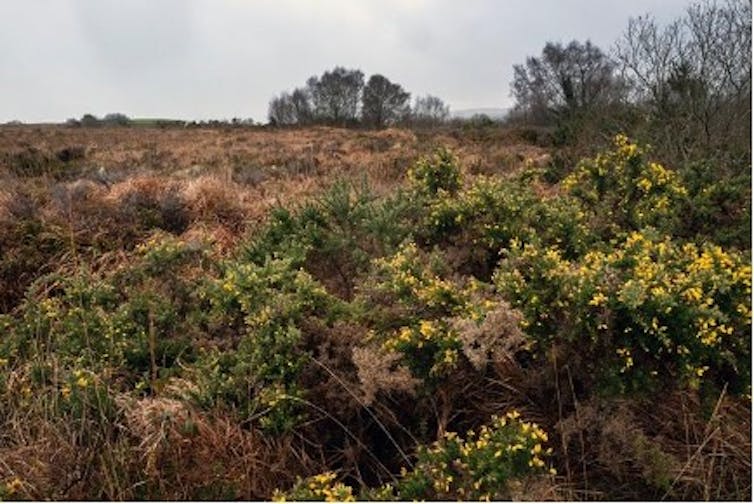
Sheila told us about moving to America and how her future husband came to bring her back to Ireland. Personal histories are woven into landscapes, rivers and journeys.
Some questions – and answers – about America and Apple Pie
Ten years in America. I have it all behind me. Did you eat hot dogs I did not Are you a good cook Reasonably good I guess I didn’t poison anyone. Roast beef on Sunday, Apple Pie. Is there are secret to apple pie? There isn’t really. How do you do it? I roll out the pastry. What kind of apples? Green apples. Did they have apple pie in Boston? They did when I was there…
Stories, meaning and history
Sometimes stories tumble out. Sometimes there is silence. It takes discipline to resist filling that silence. A person living with dementia may need up to 90 seconds to process a question. If we interrupt, we reset that process. This can be deeply frustrating for them. For the listener, the silence can feel endless.
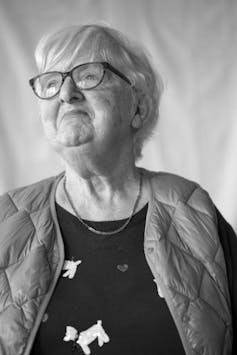 Sheila, County Mayo, Ireland.
The Keepsake Chronicles, Author provided (no reuse)
Sheila, County Mayo, Ireland.
The Keepsake Chronicles, Author provided (no reuse)
Holding space while someone gathers their thoughts is often what allows stories to emerge. Families frequently tell us they are surprised by what their relatives share, saying they did not realise they still had it in them to tell their story.
The stories and photographs are brought together in a book and returned to each participant. We could talk about reducing stigma around dementia, but the Keepsake Chronicles demonstrate this quietly and powerfully. When someone makes a room laugh, cry or sit in awe, it becomes impossible to deny their meaning and history.
People living with dementia may struggle with word-finding and memory, but they still have something to say. If we listen carefully enough, we can hear the essence of it.
- Dementia
- Storytelling
- Dementia care
Events
Jobs
- Research Fellow, Mathematical Modeller
-
 Visiting Professor - 2027 Australia-Korea Chair in Australian Studies at Seoul National University
-
Department Chair and Associate Professor/Professor of Media and Communication
-
Senior Manager, Professional Experience
 Visiting Professor - 2027 Australia-Korea Chair in Australian Studies at Seoul National University
 Department Chair and Associate Professor/Professor of Media and Communication
 Senior Manager, Professional Experience
- Editorial Policies
- Community standards
- Republishing guidelines
- Analytics
- Our feeds
- Get newsletter
- Who we are
- Our charter
- Our team
- Partners and funders
- Resource for media
- Contact us
-
-
-
-
Copyright © 2010–2026, The Conversation