- Home
Edition
Africa Australia Brasil Canada Canada (français) Català España Europe France Global Indonesia New Zealand United Kingdom United States Skip to content Edition:
Global
Edition:
Global
- Africa
- Australia
- Brasil
- Canada
- Canada (français)
- Català
- España
- Europe
- France
- Indonesia
- New Zealand
- United Kingdom
- United States
Academic rigour, journalistic flair
From Japanese walking to 75 Hard: what the science really says about viral fitness trends
Published: March 11, 2026 5.02pm GMT
Jack McNamara, University of East London
Author
-
 Jack McNamara
Senior Lecturer in Clinical Exercise Physiology, University of East London
Disclosure statement
Jack McNamara does not work for, consult, own shares in or receive funding from any company or organisation that would benefit from this article, and has disclosed no relevant affiliations beyond their academic appointment.
Partners

University of East London provides funding as a member of The Conversation UK.
View all partners
DOI
https://doi.org/10.64628/AB.sdq3ja64y
 YAKOBCHUK VIACHESLAV/Shutterstock
https://theconversation.com/from-japanese-walking-to-75-hard-what-the-science-really-says-about-viral-fitness-trends-277339
https://theconversation.com/from-japanese-walking-to-75-hard-what-the-science-really-says-about-viral-fitness-trends-277339
Link copied
Share article
YAKOBCHUK VIACHESLAV/Shutterstock
https://theconversation.com/from-japanese-walking-to-75-hard-what-the-science-really-says-about-viral-fitness-trends-277339
https://theconversation.com/from-japanese-walking-to-75-hard-what-the-science-really-says-about-viral-fitness-trends-277339
Link copied
Share article
Share article
Copy link Email Bluesky Facebook WhatsApp Messenger LinkedIn X (Twitter)Print article
If TikTok fitness advice is to be believed, you should be interval walking like the Japanese, hanging from a pull-up bar every day and committing to a 75-day challenge with no rest days.
Some of these trends are grounded in scientific research. Others are built on shaky claims or misunderstandings of how the body actually adapts to exercise.
Social media has made fitness advice more accessible than ever. But a review has raised concerns about the accuracy and quality of online fitness content, much of which is produced by creators without relevant qualifications.
So which viral workouts actually hold up when you look at the evidence? Here’s what the science says about four of the most widely shared trends.
Japanese walking
According to an analysis of Google search data, “Japanese walking” saw a 2,968% increase in search interest over the past year. The method is simple: alternate three minutes of brisk walking with three minutes at a gentle pace for around 30 minutes.
What makes this trend unusual is that it’s actually grounded in peer-reviewed research. Developed by researchers at Shinshu University in Japan, a randomised controlled trial studied 246 adults (average age 63). The interval walking group showed significantly greater improvements in thigh muscle strength, aerobic capacity and blood pressure than a steady-pace group. A 2024 review confirmed these benefits hold up across larger populations.
There are caveats, though. In the original study, roughly 22% of participants dropped out of the interval programme – more than in the steady-pace group. And no study has yet linked Japanese walking directly to living longer. We already know that hitting a modest daily step target reduces the risk of death and disease. Japanese walking appears to be a useful upgrade to a regular walking habit – but it’s not the only way to get moving.
75 Hard
The 75 Hard challenge is one of the most widely shared fitness trends on TikTok. The rules: two 45-minute workouts daily (one outdoors), a strict diet, a gallon of water, ten pages of reading and a progress photo – for 75 consecutive days with no rest days.
The no-rest-days rule is the most problematic element. Physiological adaptation to exercise, the process by which your body becomes fitter, doesn’t happen during training. It happens during recovery. Exercise creates a controlled stress; given sufficient rest, the body rebuilds and adapts.
Without it, you accumulate fatigue rather than fitness. A joint consensus statement from the European College of Sport Science and American College of Sports Medicine outlines how sustained overload without adequate recovery can progress to overtraining syndrome: chronic fatigue, declining performance and increased susceptibility to illness and injury.
Read more: 75 Hard: what you need to know before taking on this viral fitness challenge
The 90 minutes of daily exercise also far exceeds the World Health Organization’s guideline of 150–300 minutes per week. For someone currently inactive, jumping to 630 minutes a week is a recipe for injury, not transformation.
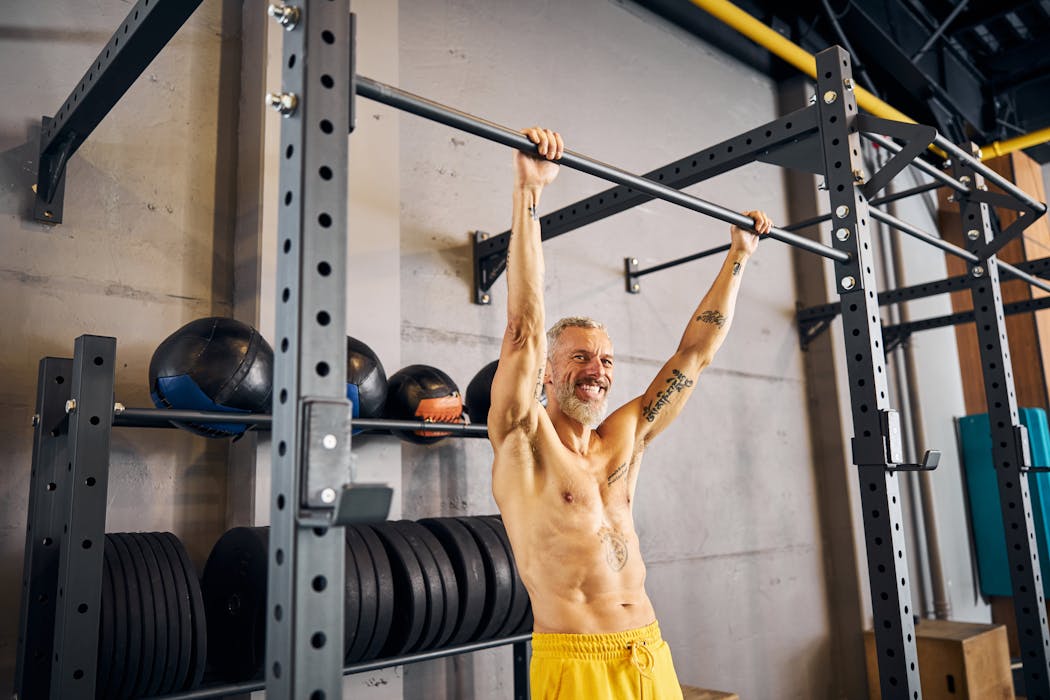
Dead hangs
Dead hangs (hanging from a pull-up bar for as long as possible) are a fixture of fitness social media. Proponents claim the exercise decompresses the spine, corrects posture and transforms shoulder health. Some of these claims hold up better than others.
The strongest case for dead hangs is grip strength. This might sound unglamorous, but it’s clinically significant. A 2019 narrative review described grip strength as an “indispensable biomarker” for health, with multiple meta-analyses linking weak grip to higher mortality risk. The PURE study, which tracked nearly 140,000 adults across 17 countries, found grip strength was a stronger predictor of cardiovascular death than systolic blood pressure.
Read more: What are dead hangs? What are the shoulder pain risks and how do I do them safely?
The “spinal decompression” claims, however, are less convincing. While gravity-based traction can temporarily increase disc height, the spine returns to its normal state once you’re back under gravitational load. No study has shown that brief bouts of hanging produce lasting spinal changes. Dead hangs are a useful exercise, just not for the reasons most often claimed.
Pilates
Pilates was the most-booked workout globally on ClassPass for the third consecutive year, with reservations up 66% from 2024. Research supports its benefits: a systematic review found strong evidence that Pilates improves flexibility and dynamic balance in healthy people, with moderate evidence for muscular endurance.
Read more: What is reformer pilates? And is it worth the cost?
Where the evidence falls apart is the claim that Pilates builds “long, lean muscles”, as opposed to “bulky” ones from lifting weights. This is a myth. Muscle length is determined by anatomy, where each muscle’s tendons attach to bone. No form of exercise can change that.
What Pilates can do is improve the range of motion around a joint and build endurance under lower loads. But the “lean versus bulky” framing has no basis in physiology, and risks discouraging people from progressive strength training, which carries substantial benefits for bone density, metabolic health and cardiovascular risk.
Social media has got more people interested in exercise – and that’s genuinely valuable. But viral appeal is not the same as evidence. The principles that actually keep people healthy haven’t changed: build up gradually, allow time to recovery and be sceptical of anything promising dramatic results in an unrealistic timeframe.
- Exercise
- Fitness
- Pilates
- Social media trends
Events
Jobs
- Research Fellow, Mathematical Modeller
-
 Visiting Professor - 2027 Australia-Korea Chair in Australian Studies at Seoul National University
-
Department Chair and Associate Professor/Professor of Media and Communication
-
Senior Manager, Professional Experience
 Visiting Professor - 2027 Australia-Korea Chair in Australian Studies at Seoul National University
 Department Chair and Associate Professor/Professor of Media and Communication
 Senior Manager, Professional Experience
- Editorial Policies
- Community standards
- Republishing guidelines
- Analytics
- Our feeds
- Get newsletter
- Who we are
- Our charter
- Our team
- Partners and funders
- Resource for media
- Contact us
-
-
-
-
Copyright © 2010–2026, The Conversation