
- Home
Edition
Africa Australia Brasil Canada Canada (français) España Europe France Global Indonesia New Zealand United Kingdom United States Skip to content Edition:
Global
Edition:
Global
- Africa
- Australia
- Brasil
- Canada
- Canada (français)
- España
- Europe
- France
- Indonesia
- New Zealand
- United Kingdom
- United States
Academic rigour, journalistic flair
 Demanding the wrongfully accused prove factual innocence is an extremely narrow gatekeeper of justice.
(Unsplash)
DNA evidence: A double-edged sword that can actually deny justice for some wrongfully accused
Published: January 25, 2026 1.46pm GMT
Kent Roach, University of Toronto
Demanding the wrongfully accused prove factual innocence is an extremely narrow gatekeeper of justice.
(Unsplash)
DNA evidence: A double-edged sword that can actually deny justice for some wrongfully accused
Published: January 25, 2026 1.46pm GMT
Kent Roach, University of Toronto
Author
-
 Kent Roach
Professor of Law, University of Toronto
Disclosure statement
Kent Roach is affiliated with the Canadian Registry of Wrongful Conviction. His book received funding to assist in it being published in open access from the Jackman School of Law at the University of Toronto.
Partners

University of Toronto provides funding as a founding partner of The Conversation CA.
University of Toronto provides funding as a member of The Conversation CA-FR.
View all partners
DOI
https://doi.org/10.64628/AAM.9fkw4mueu
https://theconversation.com/dna-evidence-a-double-edged-sword-that-can-actually-deny-justice-for-some-wrongfully-accused-273788 https://theconversation.com/dna-evidence-a-double-edged-sword-that-can-actually-deny-justice-for-some-wrongfully-accused-273788 Link copied Share articleShare article
Copy link Email Bluesky Facebook WhatsApp Messenger LinkedIn X (Twitter)Print article
Jon-Adrian (JJ) Velazquez, a New York man who spent half his life in prison for a crime he didn’t commit, recently sued New York City and its police for US$100 million for his wrongful murder conviction. Velazquez may be known by film buffs for his role in the Oscar-nominated film Sing Sing.
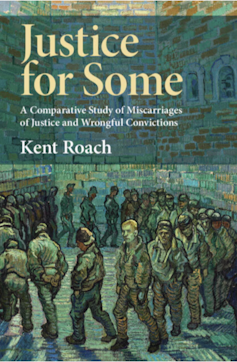 The author’s new book on wrongful convictions
(Cambridge University Press)
The author’s new book on wrongful convictions
(Cambridge University Press)
Velazquez may be entitled to millions in compensation if he can prove his factual innocence, typically through DNA evidence at the crime scene. Alas, such evidence is often not available.
The United States has paid almost US$4 billion in damages and settlements to 901 people who have been exonerated of crimes since 1989. This history of wrongful convictions is a warped form of American exceptionalism that I document in my new book Justice for Some: A Comparative Examination of Miscarriages of Justice and Wrongful Convictions .
Proving innocence
Proven factual innocence is a powerful, populist idea. It’s easier to understand and more widely accepted than concepts such as miscarriages of justice, conviction safety or judicial error, which are used to address wrongful convictions in many other countries, including England, Canada and countries in continental Europe.
These more generous approaches used outside the United States better respect the fundamental principle of giving people the benefit of reasonable doubt about their guilt.
It’s very difficult to prove factual innocence. In 2016, a New York court held that Velazquez had failed to prove his innocence despite many weaknesses in the case that led to his 2000 murder conviction.
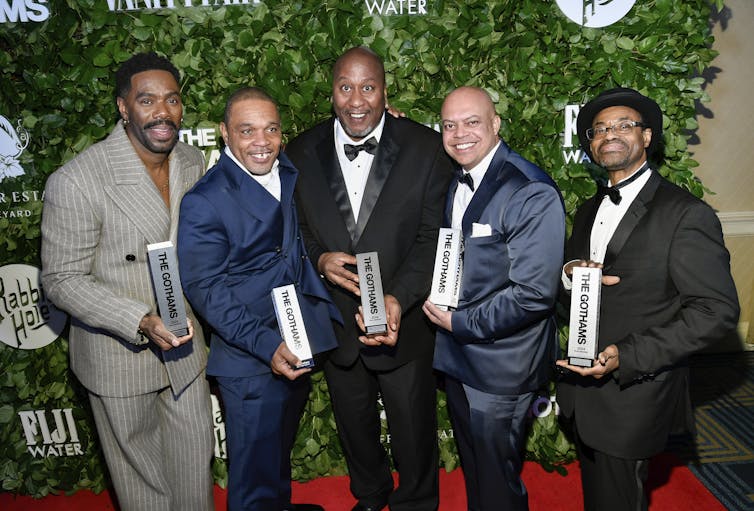 The cast of the movie ‘Sing Sing’ in December 2024 in New York at the Gotham Film Awards. Jon-Adrian ‘JJ’ Velazquez is second from the right.
(Evan Agostini/Invision/AP)
The cast of the movie ‘Sing Sing’ in December 2024 in New York at the Gotham Film Awards. Jon-Adrian ‘JJ’ Velazquez is second from the right.
(Evan Agostini/Invision/AP)
By 2016, two eyewitness who identifed Velazquez as the person who killed a retired New York police officer had recanted. Some witnesses had initially identified the perpetrator as a Black man with long braided hair; Velazquez is Hispanic and had very short hair. Some said the perpetrator used his right hand to shoot the victim; Velazquez is left-handed.
Consistent with the popular appeal of proven factual innocence, Velazquez was freed in 2021 not by the courts but by New York Gov. Andrew Cuomo, with President Joe Biden apologizing to him the following year. They were responding to investigative reporting and new DNA testing that excluded Velazquez from a betting slip that the killer touched.
The fact that politicians who may have been hoping for re-election were ahead of the American courts in exonerating Velazquez reveals a lot about the decline of the rule of law in the United States.
DNA exonerations
Prominent American lawyers Peter Neufeld and Barry Scheck, the founders of the Innocence Project, argued 26 years ago that DNA exonerations were largely a matter of luck. They predicted in a 2000 book that DNA exonerations would eventually dry up as police only use DNA testing in the small minority of crimes where the perpetrator leaves biological evidence at the crime scene.
Scheck and Neufeld may have been overly optimistic about the competence of American police and prosecutors in their book. Post-conviction, DNA-based exonerations, like Velazquez’s, continue to this day.
DNA is a double-edged sword: it offers compelling evidence of innocence while simultaneously raising the threshold for overturning wrongful convictions. In the U.S., the wrongfully convicted are often expected to prove their innocence through DNA, even though many crimes leave no biological evidence and existing samples are frequently mishandled or unavailable. DNA, in short, serves only a fraction of those wrongfully convicted.
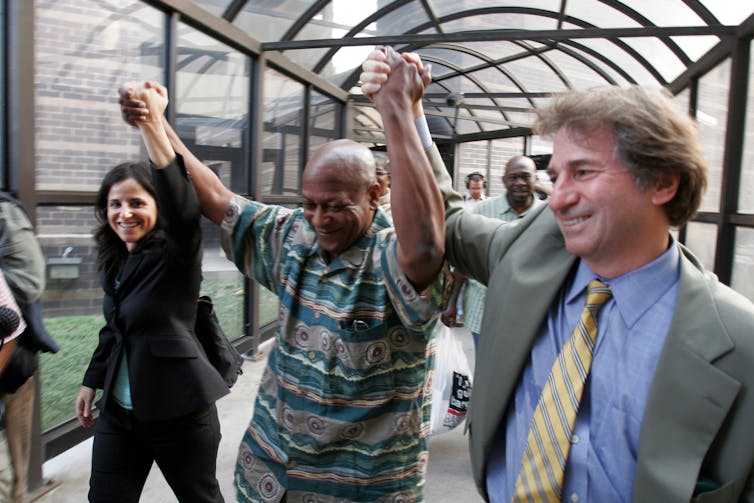 Larry Fuller, centre, with Innocence Project lawyers Barry Scheck, right, and Vanessa Potkin, walks out of a Dallas courthouse in 2006 after he was freed when DNA evidence exonerated him after serving more than 25 years in prison.
(AP Photo/Ron Heflin)
Larry Fuller, centre, with Innocence Project lawyers Barry Scheck, right, and Vanessa Potkin, walks out of a Dallas courthouse in 2006 after he was freed when DNA evidence exonerated him after serving more than 25 years in prison.
(AP Photo/Ron Heflin)
Mass imprisonment in China and the U.S.
The country most closely resembling the U.S. in its insistence on proof of factual innocence is the People’s Republic of China.
Like the U.S., China typically remedies miscarriages of justice only after multiple court proceedings. Intervention by politicians also plays a critical role in obtaining justice for the wrongfully convicted, as it did in the Velazquez case. China has also begun providing more generous compensation to those who can prove their factual innocence.
In both countries, generous compensation for the few who can prove factual innocence risks legitimizing unjust systems that harshly punish the many, including those with wrongful convictions but no meaningful path to justice.
American legal reformers have proposed that a right to claim factual innocence should be added to international law. I argue in Justice for Some, however, that proof of factual innocence would have regressive implications in many other parts of the world that correct miscarriages of justice without such onerous proof. In short, factual innocence would provide justice for fewer people.
Read more: The use of technology in policing should be regulated to protect people from wrongful convictions
Factual innocence spreads to England
Countries other than the U.S. and China are not immune from the populist appeal of factual innocence.
Since 2014, England has required proven innocence for compensation. This has drastically reduced compensation payments. It’s even resulted in the denial of compensation to people like Velazquez who have been exonerated by DNA.
Victor Nealon spent 17 years in a British prison after being convicted of attempted rape. His lawyers eventually discovered an unknown person’s DNA on clothing that had not been disclosed by investigators, and his conviction was quashed.
Nealon took his compensation claim to the European Court of Human Rights. It ruled in a divided decision that states can require proven innocence without breaching the presumption of innocence. In essence, this allows the wrongfully accused to be denied compensation without regard to the fundamental legal principle that people are presumed innocent until proven guilty. Factual innocence requirements can spread from compensation to appeals from convictions.
Read more: Eyewitness misidentification is the leading cause of known wrongful convictions
Those who can prove their innocence deserve justice — but justice should not be limited to them alone. Proven innocence rations justice too narrowly.
It may be the best that mass-incarceration societies like the U.S. and China have to offer. But even though factual innocence is popular and easy to grasp, applying this standard broadly across liberal democracies would likely have regressive effects.
- DNA evidence
- Mass incarceration
- Wrongfully accused
- Innocence Project
Events
Jobs
-
 Lecturer, Nursing
-
Postdoctoral Research Fellow or Research Fellow
-
Lecturer / Sr. Lecturer / A/Professor in Statistics for Omics
 Lecturer, Nursing
 Postdoctoral Research Fellow or Research Fellow
 Lecturer / Sr. Lecturer / A/Professor in Statistics for Omics
- Editorial Policies
- Community standards
- Republishing guidelines
- Analytics
- Our feeds
- Get newsletter
- Who we are
- Our charter
- Our team
- Partners and funders
- Resource for media
- Contact us
-
-
-
-
Copyright © 2010–2026, The Conversation